Tuesday, 18 August 2026

Birds


Liam had no idea what to expect as he knocked on the door. Aunt Jemma was formidable at the best of times. Now she had lost her favourite sparring partner and was likely to be more irritable than normal. There was a pause and he knocked again.

He still felt battered after losing Mum so suddenly. One minute she had been giving him, his wife and his kids the benefit of her relentless attention. The next minute, she was gone. Without her whirlwind entrances as she swept in and started cleaning, or cooking or checking homework, or gardening, his home was strangely quiet and it felt neglected. His wife had taken more than her fair share of his mother’s version of encouragement but she was unexpectedly shaken and lost.

The only thing that had diverted Mum’s formidable energy had been her ongoing, low level, continuous verbal sparring with her sister-in-law, Aunt Jemma. Everyone had thought it a blessing that the two strong-willed ladies spent so much of their energy on each other. In their battlegrounds of the local church, the Women’s Institute and the local charity shop, they were known for their organisational ability, insight, creativity and their ongoing arguments. When Dad died, the vicar swore that the only thing that pulled Mum through her devastated grief was the furious argument she had with Aunt Jemma about the funeral flowers. Things were certainly going to be quieter.

Liam looked around. The garden was looking shabbier than usual, and the array of birdfeeders was empty and forlorn. He felt a twinge of worry and knocked again. He should have thought to check up on Aunt Jemma. She didn’t have much in the way of family. She had encouraged her son to go for the high flying job in London and insisted that her daughter follow her husband to the fantastic job offer in Canada, which left Liam as the only local family she had. He felt a twinge of guilt. Aunt Jemma had always been good to him and his family and he had let her down. But it had been so busy with the funeral and then the arrangements. Mum had been as ruthlessly organised with her affairs as she had with everything else. But even with her meticulous preparation, there had still been so much to do.

Liam stepped back suddenly and nearly overbalanced on the step as Aunt Jemma opened the door. She had lost weight, and her usual immaculate hair was hanging loose and unstyled. She was wearing a dressing gown and she looked lost. “I should have called,” Liam said, “But I knew that it wasn’t your day for the charity shop and there was nothing on at church…” he trailed off. “Are you okay?”

Aunt Jemma forced a smile. “It’s good to see you. Come in and have a cup of tea, if you have time.” A flash of her old spirit showed. “But in a proper cup, not a mug like you use at home. At least your mother got that right!”

Liam trailed in after her as she turned towards the kitchen. “Have you been ill, Aunt Jemma?” he asked.

She looked over his shoulder. “I suppose old age is finally catching up on me,” she said. “Sometimes you have to accept that. Losing your mother was a reminder.”

“Do you want me to fill the bird feeders for you?” Liam asked. “I can do that while I’m here. I know that you like to watch your feathered visitors.”

Aunt Jemma shrugged. “I think that I’m out of bird food,” she said. “I’ll have to get some at some point. Anyway, what can I do for you?”

Liam felt the insight spark in his brain. Aunt Jemma didn’t need sympathy. She needed action. “Well, I wonder if you could come around for Sunday dinner. To be honest, I was considering putting up bird feeders so the kids could watch the birds and I think I could do with some advice. Now that the kids are getting older, I think it would be good for them to have the responsibility of keeping them topped up.”

Aunt Jemma looked at him thoughtfully. “Finding a job for me? I’m getting on now, and I don’t have the energy I used to,” she said.

Liam thought that she had had more than enough energy until a month ago when they lost Mum but kept that to himself. “I’m not suggesting that you do anything,” he said. “But I’d be grateful for your thoughts. And I can pick up bird food for you while I pick up some for us.”

“I’m not quite on my deathbed yet,” Aunt Jemma said. “I can pick up bird food. You can come with me once I’m changed and we can go down and I’ll sort some feeders and food out for you while we’re there.” She nodded to herself as she filled the kettle with a lot more purpose than she had shown earlier. “And your wife will be missing your mother, of course. I know how much your mother helped. Mind you, I daresay that you’ll be glad to have less interference, but I won’t speak ill of the dead.” Aunt Jemma plugged in the kettle and pulled out two china mugs. “I suppose she would be glad of a few words of encouragement now and again.”

“We’d be glad to see you,” Liam said. “And I brought this over.” He handed over a package. “It was left to you in Mum’s will.”

Aunt Jemma took her time putting the teabags in the mugs before taking the package and removing the protective brown paper. “I’m glad that she thought of me,” she said. She looked for a moment at the elderly print in the plain oak frame. “Well I never!” Aunt Jemma stared for a moment and then chuckled. “I suppose that she has got the last laugh. She always said that it was a Pre-Raphaelite, and I always said that I don’t care if the painter was Sir Edward Burne-Jones, how can a picture of birds be Pre-Raphaelite?” She shook her head. “And your mother knew that I always loved this picture.” She put the paper neatly in the recycling bin, marched into the living room and took down a landscape, hanging the birds in its place. “Finish making the tea, Liam,” Aunt Jemma said. “I’ll go and get ready and then we can get out and to the stores. I’ll soon get you sorted out.”

Liam smiled properly for the first time since the funeral. He was sure that he would be relentlessly ‘sorted out’ but it would be absolutely worth it.


Decorating the Tree


Vera sighed and put the last bauble on the tree. She had worked for Marlowe and Marlowe, Solicitors, for thirty seven years and had been the one to put the tree up for thirty three of them. It had been easy enough with Old Mr Marlowe. He had just handed over some money from the petty cash and let her get on with it. Young Mr Marlowe had insisted on going with her for any shopping for Christmas, which was tiring. It wasn’t as if she hadn’t handed in receipts tallied down to the last halfpenny, back when they still had them. Vera sighed again. Now the grandson, who insisted on being called Matthew, had brought in the tree himself, without any sort of consultation. It was far too big for the office decorations that now looked rather sparse, and he had bought a real tree instead of replacing the rather dusty artificial tree in the back of the cupboard. It would be shedding needles for weeks.

“I like the scent of a real Christmas tree,” Matthew had said, rubbing his hands with glee.

“That’s what reed diffusers are for, Mr Matthew,” Vera had replied. “And I’m not sure what the cleaning staff will think.”

“They’ll be fine,” Matthew said. “But pick up a few of those diffusers as well. I’ll give you the money out of the petty cash.”

That was the problem. Young people didn’t understand. She already went around with a damp cloth to clear up where the cleaners had missed. And it looked so half hearted. Anyone would tell you that you needed red baubles on a real Christmas tree. But Mr Matthew couldn’t be told.

Her mind drifted a little. Her children had been the same. Daphne had seemed to have learned and had obediently followed her mother’s instructions about what to wear and where to work. She hadn’t need to be told twice when she was wearing unsuitable make up or when the earrings she had bought were too big. She knew the correct way to wrap a Christmas present and address a card. She had listened until she ran off with that unsuitable young man to go and live in Australia. Vera got letters twice a year with pictures of her grandchildren, and they all seemed happy enough, but it wasn’t the same.

Edward, well, her son had always been tricky. She had tried. After Daphne had left, she had tried to get Edward to understand the correct way of dressing a Christmas tree. He had refused to touch it at all. Her husband had been no help either. And now Edward had gone off to live with that Jackie woman. They seemed to thrive on the chaos surrounding them and last year they had had a pink artificial tree. Vera picked up a stray pine needle and inwardly shook her head. She had tried to explain to Jackie where they were going wrong and the explanation had become a discussion which had turned into an argument which ended up as a flaming row and they hadn’t spoken since.

Vera stepped back to get a look at the tree, nodded to herself and then straightened the coffee machine before settling back at her desk. Year after year she had been the one to dress the tree, here and at home, and it didn’t seem to get any easier. She scrolled through the emails. It was only her and her husband for Christmas this year, but at least the tree was done right. She could take satisfaction in that.


Saturday, 15 August 2026

Don't Forget the Flowers


Image from Unsplash taken by Anastasiya Leskova

I had nearly forgotten the date. I had to rush out and pick up the flowers from the nearest florist in a hurry. I never wanted to miss the flowers on this day of all days.

“Promise me you will buy flowers on my birthday,” my aunt had said. Her fingers had been like claws as they clung onto me. I had stared at the dying woman, in the borrowed hospital bed in her bedroom. The nurse had stared sympathetically at me as the light faded with my aunt and the scent of disinfectant filled the air. “Promise me, every birthday, you buy flowers.” She had broken off, coughing.

I had nodded. “I promise, Aunt Carol. I’ll buy them every year.”

“I should have changed my will,” she had gasped. “I should have made you earn it.”

“Don’t make yourself poorly, auntie,” I had said. “I can get the solicitor in any time.” I had ignored the tiny shake of the nurse’s head. We both had known that my aunt had hours left, but there was no point in upsetting her.

“Flowers on my birthday, keep the house the same, no men, and no foreign food. Remember.” Aunt Carol had coughed and gasped and then fallen back on the pillows, exhausted. They were the last words she ever said.

That was three years ago. Aunt Carol had taken me in when I had lost my parents at the age of fourteen. She had terrorised me, gouged every penny of support for herself and sabotaged any chance I had to make a life away from her. I had cleaned her sparse and spartan house, ran her errands and survived. I even gave up my job to nurse her at the end. I had done my duty. All the money she had clawed from my trust fund, along with all the other money that she had hoarded, was left to me. She had never found a way of adding the clauses that she wanted, so she had just insisted, expecting me to be the good, obedient child that I had always been.

Today would have been her birthday. So I ran out and bought a huge bunch of tulips, a flower that she had loathed. I would put them among the cosy throws and knickknacks that she had hated. And later my gorgeous boyfriend would call, and he would bring a curry.

A Date and a Church


Image from Unsplash taken by K Mitch Hodge

“How are you going to find a decent husband if you don’t go to the right places?” My mother was almost incandescent. “History walk! What a lot of nonsense. All there will be is the unemployed and pensioners.”

“It’s not all about getting a husband,” I said. “I run my business, I take care of you and dad, I have my hobbies…”

“Your hobby should be finding a husband!” Mum waved her hands in exasperation. “And look at you. I know how much you are earning these days – and an unmarried woman at that! – but you don’t look it. You should go to a decent stylist, perhaps, and dress a little better.”

“I dress fine in the office,” I said wearily as I dragged my coat on. “And there’s nothing wrong with what I wear.”

“I want grandchildren,” Mum snapped. “And with a nice young man, not some old fogey that’s older than me. Why won’t you meet with Darren Sharp? He’s a barrister and I’ve known his mother for years!” I let her voice trail into the distance as I dashed out.

I had been looking forward to the history walk for months. It took me a few minutes, but I managed to shake off my mother’s mood and join the group. I had not been allowed to forget that I was nearly thirty and had been single for over a year. Today I was going to put all that behind me. I had been fascinated by the old church for years and I wasn’t going to miss the chance. I had had enough of my mother’s complaints.

I was one of the last to arrive and found myself next to the only one in the group who was near my age. He was a quiet looking man, perhaps two or three years older than me, with dark, short hair and an athletic build under his hoodie and jeans. He smiled wryly as I stood next to him. “Thank goodness I’m not the only non-pensioner here.”

I chuckled quietly as I looked at the rest of the group. I guessed that most of them were thirty or forty years older than me. I knew a few of them, and they were great fun, but I agreed, it was fun to have a contemporary around.

“Listen up, everyone,” an elderly man at the front called out. “I’m Vivian, and I’m the guide for today. Can everyone hear me at the back?” He looked around carefully and then, with some ceremony, pulled out some handwritten notes. “Right, thank you for coming to this guided walk. I’m sure that you all will find it educating and entertaining. I’m Vivian and I have been the churchwarden here for forty three years. Let me introduce you to this beautiful building. St Cuthbert’s church has been standing on this site since the Anglo Saxons, but the current building was erected on this site later, starting in the reign of King John, the one who signed the Magna Carta in 1223.”

“1215,” I muttered automatically, then glanced, embarrassed at my companion.

He nodded. “John died in 1216, before the church was started.” We grinned at each other.

Vivian cleared his throat and gave us a dark look. “As I was saying, the church was started 1223 with money from the local lord, Lord Robert, during the reign of King John, son of the famous Richard the Lionheart.”

“Brother,” I murmured. “John was Richard’s brother.”

“Hasn’t he even seen the Disney cartoon?” my companion said.

We hushed quickly after catching Vivian’s expression, and trailed after him as we passed through the lych gate and up towards the church porch.

We deliberately fell behind. As an architect, I could talk easily about the building, and he was wonderfully knowledgeable about the religious side. We could hear Vivian butchering history but let it drift over us as we marvelled together at the beautiful late Anglo Norman stonework and the Victorian stained glass. Time seemed to fly by as we talked and talked, and we had to hustle as Vivian led the rest of the group back to the church door and waved his keys pointedly.

We walked back to the car park. He raised an eyebrow at my Range Rover. “Nice car.”

“I’m not always in the office. I do site visits and I need something reliable.”

He nodded. “I’m always in an office, so I just go for comfort,” he said, as he waved a hand at the Volvo parked next to me. He smiled. “I’m glad you were here. I think I would have murdered the churchwarden if I’d had to listen to him.”

I nodded. “He meant well,” I said, “But he missed so much.”

“I’m going to a talk on Medieval Crosses next Tuesday evening,” he said. “Would you like to come? I’ll even buy you dinner afterwards.”

He had a lovely smile, and I smiled back. “I’d love to. I’d better give you my contact details, just in case.” I pulled out a business card. “I’m Kylie Brenner.”

He stared at me. “Kylie Brenner? Kylie Brenner the architect? The one who’s mother is a great friend of Imelda Sharp?”

I nodded slowly. “That’s right.”

He grinned. “I’m Darren Sharp. I’ve been hiding from you for months.”

I laughed. “I can’t believe it. Well, despite all the efforts of my mother, I would still love to come to the talk and dinner,” I said. “But perhaps we shouldn’t tell our mothers.”

“Perhaps not,” he agreed.

Flowers

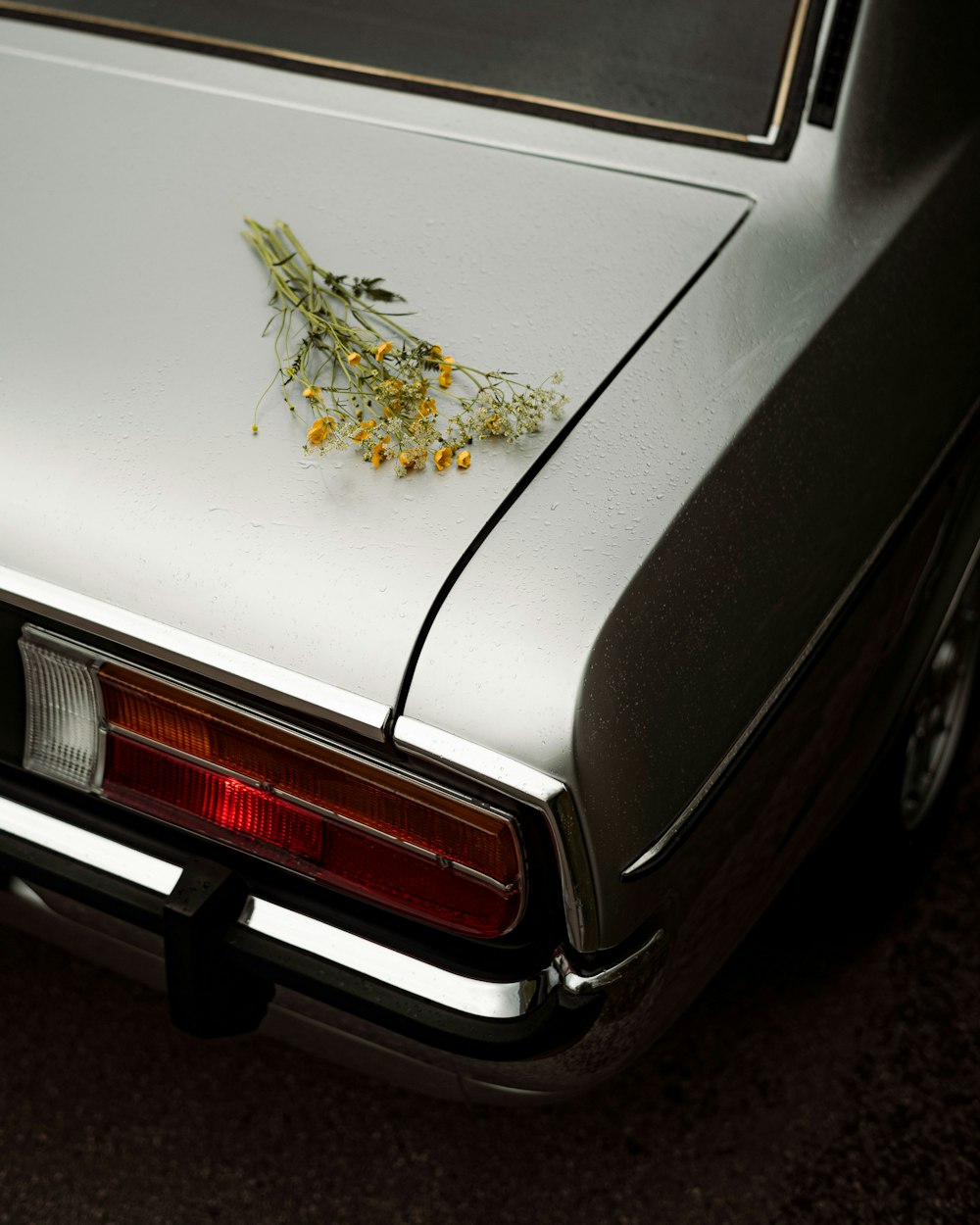
 green and yellow plant on white car

Image from Unsplash, taken by Maurice Pehle

“The flowers are late!” I rushed into the kitchen, my wedding dress bunched around my waist and my veil askew. I looked at my husband-to-be. “I knew we shouldn’t have trusted that florist.” I took a deep breath. “And I knew we shouldn’t have got ready together. It’s supposed to be unlucky.”

Tim sighed. “It’s just nothing. It’s probably meant to allow the bride a little peace to get ready without the groom asking a lot of questions and causing fuss. We aren’t doing all the fuss.”

It made a sort of sense, but I was still frantic. “What about the flowers?”

“Can’t your little friends help out with that?” Tim asked.

“You know I don’t like you calling them that,” I said. I manouevred my skirt over a stool and sank down. “They’re the fair folk – if you have to talk about them at all.”

Tim walked over to me, put his hands on my shoulders and kissed me gently on the forehead. “Well, whoever they are took a lot of getting used to. I’m still not sure they approve of me. But I love you, friends and all, and don’t worry.” Tim grinned, that crooked grin that I loved so much. “Besides, they’re more like family, really, and we all have awkward family. I mean, you’ve met my Auntie Violet. She is far worse than misplaced car keys and iffy reception for the radio.”

I smiled back for a moment. “Lots of people call this house haunted, but it isn’t really. I just have friends.” My face fell. “But no flowers – and you know that the minister said he wouldn’t go ahead if we were late. We can't wait around for the dratted florist. What are we going to do?”

Tim took my hands and gently squeezed them. “My darling, we agreed that this is about the marriage that we are going to have for the rest of our lives, not one day. We agreed that we would remember the things that went wrong as fun stories and not as awful events.” He grew serious. “I wish my mum was able to come, but we lost her last year. I wish your family was still here. I wish that your bridesmaid hadn’t eloped with my best man a week before it was all due to happen. I wish all sorts of things. The flowers, well, it’s just another story. As long as we get married, that’s all that matters. I love you.”

I smiled back. “I love you too.” I sighed. “I hope the fair ones are happy. They haven’t interfered so far, which is a good sign.” I disentangled my voluminous skirt from the stool and stood up. “They mean a lot to me.” I pulled myself up and settled my veil. “They’re the last of my family. Come on, we can’t be late. We can do without the flowers. Let’s go and get married.”

Tim led me outside ready to drive to the church, then stopped. I almost fell over as I bumped into him and then stared. A small bundle of wild flowers lay across the boot of the rental car.

Tim picked them up tenderly and looked around. “Thank you for this,” he said to the empty air. “An amazing gift on our wedding day.” He turned to me. “Your family have given their blessing. Let’s go and get married.” He looked around again. “And I’ll save you some cake!”

The Picture


Image from Unsplash taken by Jack Niles

“I don’t know why you’re so fascinated by that picture,” Freddie said. “It’s nothing special. My mother was an art student once. She painted a few pictures.”

Alice continued to stare at the painting. “Why?” she asked. “Every time I see that picture I ask myself, why? Why did she frame it like that?”

“I don’t know,” Freddie said impatiently. “You know what my mother was like. She probably found a cheap frame.”

“But it’s a shame. It should be mounted properly, with a proper matte backing and a larger frame, perhaps a darker one, and a decent amount of wood, not those skinny sticks.”

“Well, it’s all ours now, so take it and reframe it.” Freddie looked around his late mother’s flat. “All of this is ours now. What a mess.”

“You keep saying that your mother had money, and the will said that she left it to you and to not waste what you’re given, but there’s nothing really here.” Alice stared at the painting. “Except this painting.”

“It’s just something she did as an art student.” Freddie frowned and checked the piece of paper in his hand. “The solicitor said that she talked about having planted the money in the flat.”

“Planted…” Alice murmured, still staring at the picture. “Mind you, I don’t think she had two pennies to rub together. Look at the state of this flat.”

“She was careful with her money,” Freddie said. “And she liked a bargain.” He glanced at his expensively dressed wife. “You could have learned a thing or two.”

Alice ignored him and looked around the tousled flat. “That sofa is older than I am! And that side table is scratched to bits.”

Freddie slowly lowered himself onto the sofa and relaxed. “I remember this sofa. It’s one of the comfiest I’ve ever sat on. Mind you, it needs a new cover.” He looked at the side table, cluttered with dirty cups and dried up houseplants. “Though the table isn’t fit for anything. It was only cheap chipboard to begin with.”

Alice turned back to the picture. “Planted. Your mother really liked this painting, didn’t she?”

“Hmm?” Freddie settled himself in a corner of the sofa and looked around again.

“I mean, it’s so striking, and in such a central place.” Alice leaned over. “I bet that’s where she put her savings book. Behind the picture. Or perhaps there’s a safe.”

“She liked the picture because she already had it and it took up enough wall to make it look decorated,” Freddie said dispassionately. He looked around again. “I remember those mugs from when I was a kid. She got them as a free gift.”

“How much money did your mother leave?” Alice asked. “I mean, just a savings book with a hundred pounds or so wouldn’t take up much room.” She grasped the picture and, after a quick struggle, lifted it down.

“The solicitor who handled it all has already paid the inheritance tax and that was a fortune,” Freddie said. “It’s more than a small savings account.” He frowned, then sighed. “She did love her plants. I suppose she wanted us to take care of them, but they died before we got the news.” He reluctantly pulled himself out of the comfy corner of the sofa. “What are you doing?” he asked Alice.

“The information – it’s behind the picture!” Alice said as she wrestled with the painting. “Look, it’s about plants, and everyone knows that you can keep papers behind pictures in frames.”

Freddie shook his head and started lifting the houseplants. “You need to take that picture, reframe it, hang it where you like and then forget about it.” He lifted a formerly magnificent specimen of philodendron. Between the pot and the pot stand was a key. “The safe deposit box key. Mother was never that complicated.”

Eggs for Breakfast

 white and brown heart shaped cookies

Image from Unsplash taken by Franzi Meyer

“These are hard,” my mother said. “You should make some new ones.”

“Sorry, I’ll get them done now,” I said.

“I don’t know why you can’t them right first time,” Mother complained. “It’s not like you never cook eggs.”

“Sorry,” I said as I put the pan back on the heat. “Maybe I should get the pan hotter first.”

“You never think!” Mother said. “You’re going to have to have them. I can’t have them going to waste. And what about dinner? I suppose you haven’t thought about that?”

“I’ve got some chicken out of the freezer,” I lied, knowing what would come next.

“I don’t fancy chicken,” Mother said. “I think that we eat too much chicken. Is that toast fresh?”

“Yes, it’s just come out,” I said as I buttered it quickly and slid it on to the plate. I pushed it over to her and cracked two more eggs into the pan.

“You could have at least cut the toast for me,” Mother said. “I have to do everything. You have no consideration for me. I’ve had such a bad night.”

“Sorry,” I repeated, as I quickly poured tea into her mug. “Here, this will help.”

Mother took a sip. “Is this milk okay?”

“It’s fine,” said, turning the eggs. “I had some in my tea when I got up earlier.”

“It tastes off,” Mother said. “Could you open a fresh carton?”

“It’s the last carton,” I said. “I usually pick it up after work, but there was that after work meeting, remember, and I didn’t have time before getting home to cook dinner.” I slid the new eggs onto her warmed plate and pushed the toast nearer.

“You’ll have to pick up some tonight, and some eggs. We seem to go through so many eggs with you wasting them.” Mother shook her head sadly. “So what are we going to have for dinner if we can’t have chicken?”

I shrugged. “I don’t know.”

“You should know!” Mother exclaimed. “You are the one in charge of the kitchen, you should know what we have. We’ll just have to order pizza. I know you say you don’t like it, but you should have thought of that before getting the chicken out. And today of all days! You know I’m out for the day with Mrs Timmins and you didn’t even press the blue dress.”

“What blue dress?” I asked, bewildered.

“The one in the wardrobe. It’s been there so long that it was looking sad. I’ve had to put on this pink one. Of course, if you took me out more, it wouldn’t matter so much.”

“But you know I work,” I said wearily and took a bite of the eggs she’d rejected. They tasted fine.

“I keep telling you that you should give up work and get carer’s allowance. You and me could be quite cosy, just the two of us here,” Mother said. “I don’t know what you need your job for. They only pay a pittance.” She looked out of the window. “There’s Mrs Timmins – I have to go! Where have you put my bag?”

I watched her leave, sipping my tea as she glared one last time at me through the window as she climbed into Mrs Timmins’ car, then breathed out. Finally she was gone. I dumped my unwashed plate and mug into the sink and raced upstairs to grab my one remaining bag. My job paid extremely well, thank goodness, though she never knew, more than enough for the very reasonable rent on a tiny flat near work. The down payment had cleared, I’d picked up the keys and today was the day I moved away from Mother and into my own home. And what was more, I thought, as I shut the door and pushed the keys back through the letterbox, I would never, ever have to eat eggs for breakfast again.

Birds

Photo by Birmingham Museums Trust on Unsplash Liam had no idea what to expect as he knocked on the door. Aunt Jemma was formidable at the ...